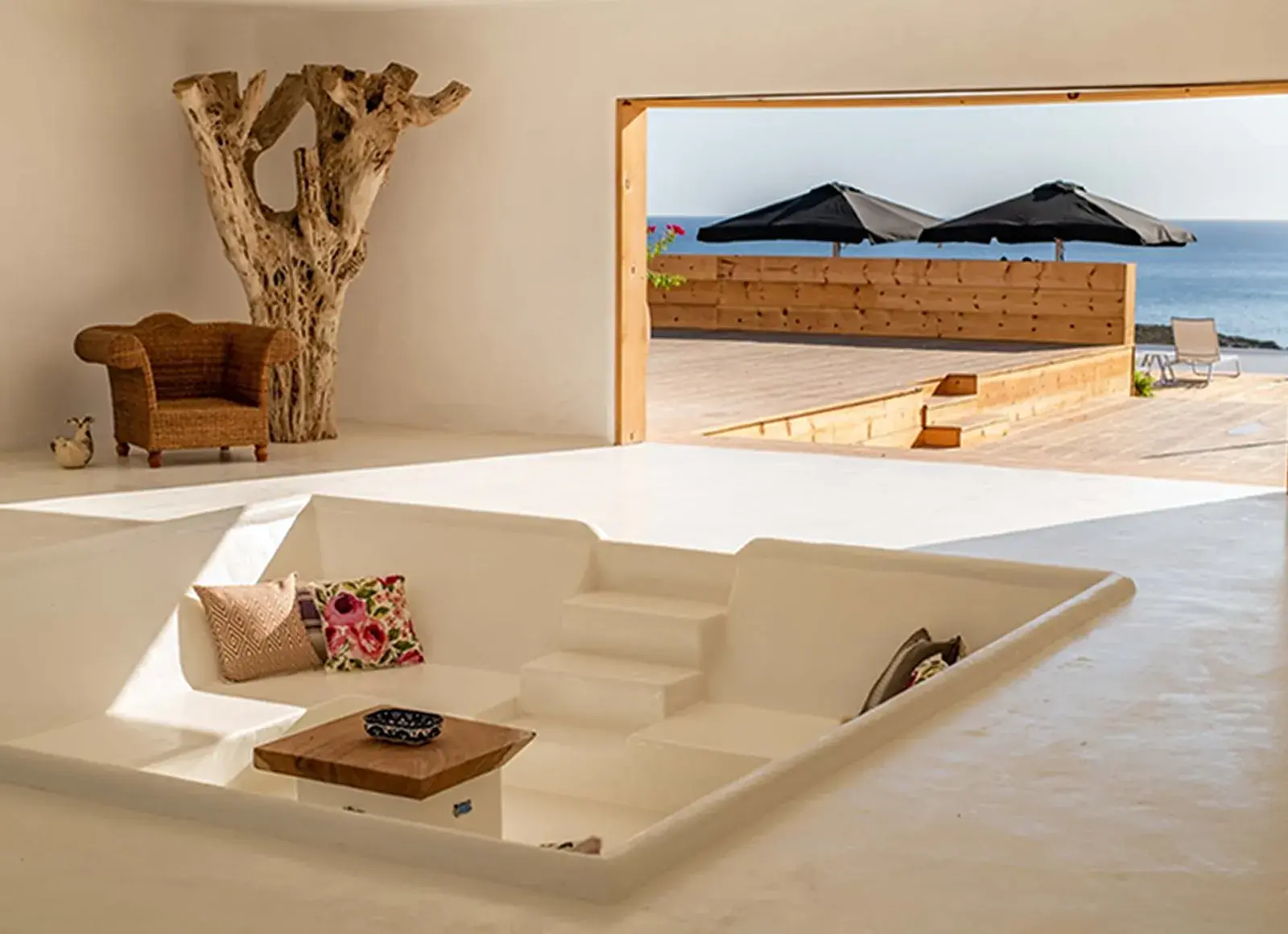
Biophilic Design in an Arid Climate: Bringing Nature Into the Desert
Biophilic design has become one of those terms that gets applied to almost anything with a plant on a shelf or a photo of a forest on the wall. That's not what I mean when I use it, and it's not how we work at Symbiotica.
Biophilic design is the practice of creating architecture that connects occupants to the natural world — not as decoration, but as a structural principle. Light, air, material, landscape, and spatial sequence all function together to make you feel, at a cellular level, that you are in a place that belongs to the earth.
In the Sonoran Desert landscape of Baja California Sur, this principle has to be completely rethought. You cannot import a tropical or temperate biophilic vocabulary and apply it here. The desert has its own logic, and working against it produces buildings that look good in one photo and fail everyone who lives in them.
What biophilic design actually means
The theory comes from biologist E.O. Wilson's concept of biophilia — the innate human tendency to seek connection with life and living systems. In architecture, it translates into:
- Direct nature contact: views, natural light, living plants, water features, natural air movement
- Indirect nature representation: natural materials, organic patterns, textures that reference the landscape
- Spatial conditions: prospect and refuge (the ability to see out while feeling sheltered), complexity and order, mystery and invitation
None of that is decorative. Each element has measurable effects on stress, cognitive performance, and sense of wellbeing. The research on this is consistent and substantial.
What it does not mean: putting a fiddle-leaf fig in the corner of a room that has no other relationship to its site.
The specific challenge of designing biophilically in BCS
Working in Los Cabos presents a particular set of constraints that make biophilic design both harder and, when done well, far more powerful than in more forgiving climates.
Water is scarce. The annual rainfall in the Los Cabos corridor averages 150–200mm, falling mostly in late summer. Any design strategy that requires regular irrigation is imposing a system that the land cannot naturally support. Lush gardens require constant water input, which is both expensive and ecologically incoherent in a desert context.
Heat is extreme. Summer temperatures consistently exceed 38°C. Direct solar exposure is not something to frame or celebrate — it's something to manage carefully. The biophilic relationship to the sun in BCS is about light quality and seasonal movement, not about bathing in it.
The landscape itself is extraordinary. The cardón cactus forest, the dry arroyo beds, the volcanic rock formations, the Sea of Cortez — this is a biophilic landscape of immense power. The job of the architect isn't to compete with it or to import something foreign into it. It's to frame it, to bring the occupant into a felt relationship with what's already there.
Native plants that don't need irrigation
This is where biophilic design in BCS becomes genuinely interesting. The endemic vegetation of Baja California Sur is adapted to survive on minimal water, and many of these plants are architecturally spectacular.
Cardón (Pachycereus pringlei)
The largest cactus in the world by biomass, endemic to the Baja peninsula. A mature cardón can reach 15 meters. In a landscape design context, existing cardones on a lot are irreplaceable assets — they take decades to grow and cannot be transplanted once large. We design around them, not over them.
Pitahaya (Stenocereus thurberi)
The organ pipe cactus, which produces edible fruit that has been harvested by indigenous communities here for millennia. Its branching form creates natural visual complexity and provides year-round structure to a landscape.
Palo Verde (Parkinsonia microphylla)
A small tree with yellow-green bark that photosynthesize even when leafless — relevant in the dry season when most deciduous plants look dead. Provides dappled shade and a delicate canopy.
Torote / Elephant Tree (Bursera microphylla)
One of my favorite plants in BCS. The torote has a swollen, sculptural trunk that stores water, smooth peeling bark, and small aromatic leaves. It looks like something a painter invented. In an architectural context, a grove of torotes around a house creates a sense of enclosure and presence that no imported plant can match.
Lomboy (Jatropha cinerea)
A shrub that creates dense, airy clusters of branches with small leaves. Excellent for screening, for defining outdoor rooms, and for attracting pollinators.
A biophilic landscape in BCS is not bare earth with a few scattered cacti. It's a designed composition of endemic species that reads as coherent and alive — because it is, and because it belongs here.
The role of shade as a biophilic strategy
In tropical biophilic design, the relationship between interior and exterior is often about openness — large doors, indoor gardens, continuous airflow. In a desert climate, the primary biophilic strategy is shadow.
Shade is the precondition for outdoor living in BCS. Without it, patios are unusable from 10am to 5pm during seven months of the year. With it, the outdoor space becomes an extension of the house — a place where you actually spend time, feel the breeze, hear the birds, and watch the light change.
We design shade through:
- Deep roof overhangs that block high summer sun while allowing low winter sun to enter
- Pergolas and ramadas in outdoor living areas, using local materials including palm thatch, ocotillo, or wooden beam structures
- Tree canopy from native species positioned to shade west and south elevations
- Interior courtyards that create micro-climates — cooler, more humid, sheltered from wind — within the body of the building
The relationship between sun and shadow in BCS can produce temperature differentials of 12–15°C across a short distance. Designing to exploit that difference is a core biophilic and passive cooling strategy simultaneously.
Materials as connection to place
Biophilic design is not only about plants and views. It's also about the physical substance of the building — what it's made of and where those materials come from.
In BCS, the most powerful material choices are the ones that carry the geology and craft of the region:
Piedra local (local stone) — The volcanic and sedimentary rock of BCS has a specific color and texture. Used in walls, floors, and terraces, it connects the building to the hillsides and arroyos from which it came. The thermal mass is also functionally important in a climate with significant day-night temperature swings.
Adobe and compressed earth (tapial) — Earth architecture is indigenous to this landscape. A tapial wall absorbs heat during the day and releases it slowly at night, moderating interior temperature without mechanical intervention. The material comes from the same soil the building sits on. There is no more direct biophilic connection than that.
Madera de palo de arco (desert ironwood) — One of the densest hardwoods in North America, used by indigenous Seri people for tools and carvings. In contemporary architecture, it appears in structural elements, furniture, and details. Sourcing must be from certified, legal channels — this species is protected.
Chukum — A traditional Mayan waterproofing material made from the bark of the chukum tree, mixed with lime and applied like plaster. It produces a smooth, warm finish that ages beautifully and is completely natural. We use it in bathrooms, kitchens, and sometimes on exterior walls.
These are not exotic imports. They are the material culture of this place. Using them creates a building that feels like it grew here rather than landed here.
Natural light and cross-ventilation
Light in a desert climate is intense, angular, and constantly shifting. Biophilic design in BCS means controlling and calibrating that light — not blocking it entirely, but not allowing it to make interiors unbearable either.
Strategies we use consistently:
- North-facing glazing for diffused, constant light without direct solar gain
- Clerestory windows positioned to bring high light into deep interior spaces without exposing walls to direct sun
- Brise-soleil and lattice screens (celosías) that filter light and create the constantly changing dappled patterns that biophilic theory identifies as psychologically restorative
- Colored glass and textured surfaces that transform direct sun into dynamic interior light quality
Cross-ventilation is covered more fully in a separate post on passive ventilation strategies, but the principle is simple: rooms designed with openings on opposing walls, aligned with the dominant northwest breeze in BCS, can remain comfortable without mechanical cooling for much of the year.
Desert biophilic design vs. tropical biophilic design
I trained in Coimbra, Portugal, and have worked across different climate zones. The vocabulary of biophilic design shifts completely depending on where you are.
In tropical contexts, biophilic design leans heavily on abundance — lush vegetation, water features, constant greenery, high humidity as a sensory element. The challenge is managing heat and rain while keeping everything alive and connected.
In the desert of BCS, the biophilic language is about:
- Restraint — the beauty of a single torote in a gravel courtyard is more powerful than a dense garden that doesn't belong here
- Contrast — the shock of shade after sun, the sound of water in a dry landscape, the coolness of a thick earth wall
- Longevity — materials and plants that age well in heat and UV, that don't require constant maintenance to survive
- Silence — the desert is quiet in a way that other landscapes are not. Architecture that respects that acoustic environment is itself biophilic
Symbiotica projects: biophilic principles in practice
In our work in BCS, biophilic principles show up in every project — not as a style or a checklist, but as a set of questions we ask from the first site visit.
Where is the prevailing wind? Where does the best light come from? Which existing plants on the lot are irreplaceable? What views should the house frame? What is the geology of this site telling us about materials?
The answers shape the building before a line is drawn. That is what biophilic architecture actually looks like.
Schedule a free consultation → info@symbioticarq.com
Frequently asked questions
What is biophilic design?
Biophilic design integrates natural elements, patterns, and processes into the built environment — not as decoration, but as a fundamental design strategy. In practice it means optimizing natural light, ventilation, views of nature, natural materials, and spatial connections to the landscape.
Can you really do biophilic design in a desert?
Yes, and the desert is arguably a richer context for biophilic design than many tropical environments. The extreme contrast between shade and sun, the sculptural quality of endemic plants, the texture of local stone — these are powerful biophilic materials. The key is working with the desert's own logic rather than importing ideas from wetter climates.
What native plants work for biophilic design in BCS?
Cardón (the iconic BCS cactus), pitahaya, palo verde, torote blanco, and lomboy are all low-water endemic species that provide shade, texture, and ecological meaning without irrigation. Integrating them into the landscape rather than clearing them is the first principle of biophilic design here.
Does biophilic design cost more than conventional design?
Not necessarily. Using local materials, preserving existing vegetation, and optimizing natural light and ventilation often costs less than importing finishes and installing mechanical systems. The investment is in design thinking, not in expensive materials.
Symbiotica
Ready to start your project?
Free 60-minute consultation — no commitment required.