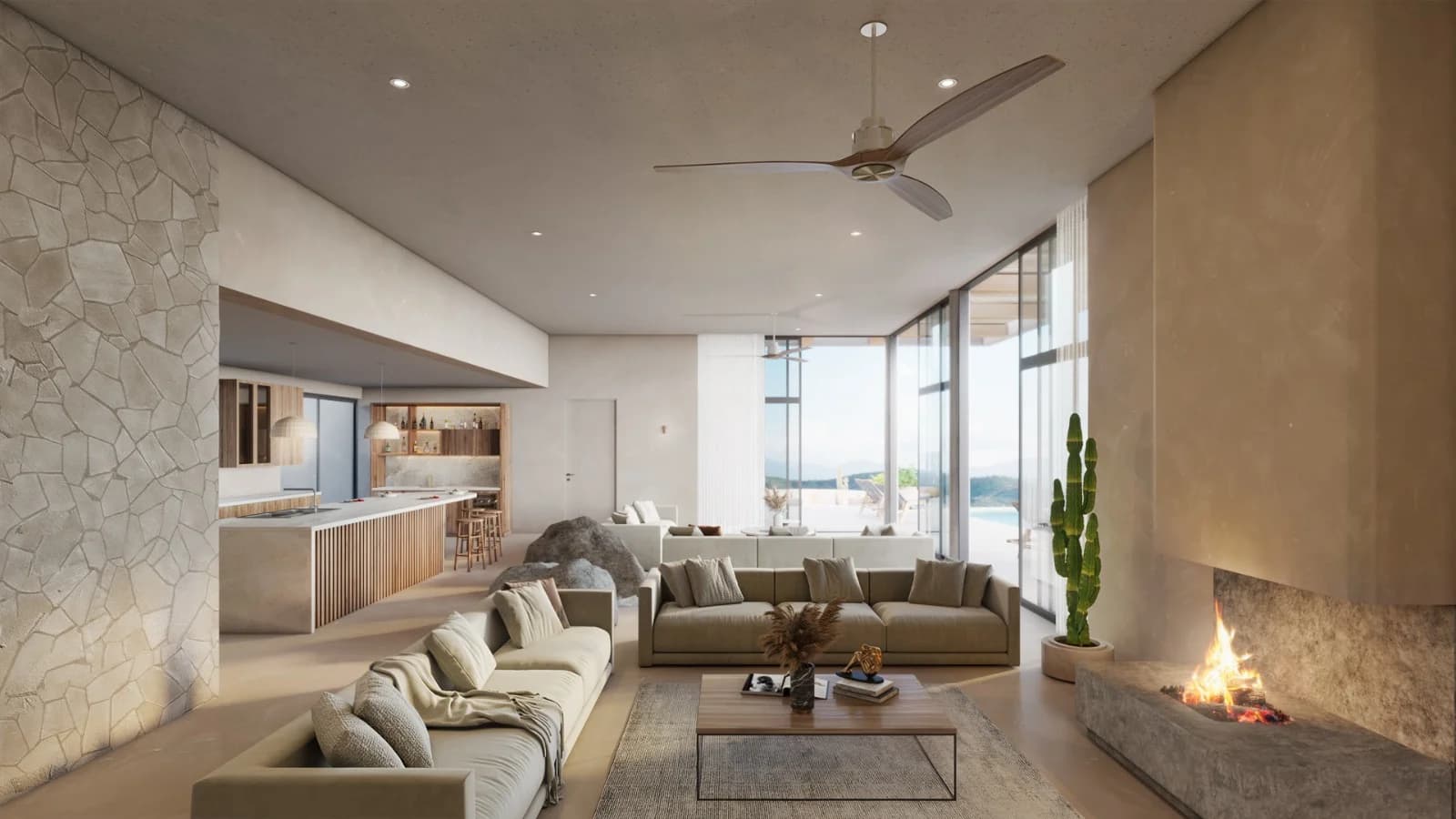
Can Foreigners Build in Los Cabos? A Complete Guide
The most common question I get from international clients isn't about design or materials. It's this: "Can I actually own land here?"
The short answer is yes. Foreigners have been buying and building in Los Cabos for decades, and the legal framework for doing so is well-established. But there are specific structures you need to use — and if you don't understand them going in, you'll make decisions that complicate things later.
This is what I explain to every international client before we talk about a single floor plan.
The Restricted Zone: what it is and why it exists
The Mexican Constitution prohibits direct foreign ownership of land within the Zona Restringida — the Restricted Zone. This zone covers:
- 100 kilometers from any international border
- 50 kilometers from any coastline
Los Cabos is entirely within the coastal restricted zone. Every beach lot, every hillside with an ocean view, every parcel within 50 km of the Sea of Cortez or the Pacific — all of it falls under this restriction.
This doesn't mean foreigners can't own property here. It means foreigners must hold that property through one of two legal structures: a fideicomiso (bank trust) or a Mexican corporation (sociedad anónima).
Option 1: The Fideicomiso (Bank Trust)
The fideicomiso is the most common structure for foreign residential property ownership in Mexico's coastal zones. It's been the standard mechanism since 1993 and is well understood by Mexican banks, notaries, and real estate professionals.
How it works
You don't technically "own" the land — a Mexican bank holds title on your behalf as trustee. You are the beneficiary of the trust. This gives you all the practical rights of ownership:
- Use and enjoy the property
- Build on it, modify it, rent it, sell it
- Transfer it to heirs
The bank holds title but cannot use or sell the property without your authorization. They are an administrative trustee, not a co-owner.
Which banks offer fideicomisos?
Most major Mexican banks with coastal branch networks offer this service:
- BBVA Mexico
- Santander Mexico
- Scotiabank Mexico
- HSBC Mexico
- Banorte
The process for establishing a fideicomiso typically takes 2–4 months and runs in parallel with the property purchase.
Cost
- Setup fee: approximately $1,500–$2,500 USD (one-time, paid to the bank and notary)
- Annual maintenance fee: approximately $600–$800 USD per year — this is the ongoing cost of keeping the trust active
- The trust runs for an initial period of 50 years and is renewable
What to watch for
Not all bank trust agreements are identical. Read the fine print on what the bank can and cannot do, the process for transferring or terminating the trust, and the fee escalation clauses. A good Mexican notary will walk you through this.
Option 2: Mexican Corporation (Sociedad Anónima)
The alternative is to form a sociedad anónima (SA) or sociedad anónima de capital variable (SA de CV) — a Mexican corporation — that holds the property. Mexican corporations can own restricted zone property directly.
When a corporation makes sense
- You're buying property for commercial or rental income purposes (the corporation can have operational advantages)
- You're planning to hold multiple properties
- You already have a Mexican business entity
- You want to avoid the annual fideicomiso maintenance fee
Considerations
A corporation requires ongoing compliance: annual accounting, tax filings with SAT, potential IMSS obligations if you have employees. For a straightforward residential property that you'll use personally, the administrative overhead of a corporation often outweighs its benefits. Most individuals buying a single lot for personal use are better served by the fideicomiso.
The property purchase process for foreigners
Here's what the process actually looks like, from start to build:
Step 1: RFC (Registro Federal de Contribuyentes)
To purchase property in Mexico as a foreigner — even through a fideicomiso — you generally need an RFC, Mexico's tax identification number. This is issued by SAT (Servicio de Administración Tributaria).
What if you don't have an RFC? Getting one as a non-resident foreigner requires a bit of paperwork: passport, proof of address in Mexico, and sometimes an appointment at a SAT office. Some banks and notaries have workarounds for foreigners establishing fideicomisos, but having your RFC in hand before you start simplifies everything. A local accountant (contador) can help you obtain it.
Step 2: Find your land and do due diligence
Not all land in BCS is created equal. Before you commit to any parcel, you need:
- Certified title search (certificado de libertad de gravamen) — confirms the property has no liens or encumbrances
- Confirmation of Uso de Suelo — the land use designation that determines what you can build
- Environmental status — proximity to SEMARNAT-protected areas, ZOFEMAT coastal zone, or Áreas Naturales Protegidas affects what you can build and how
- Utilities access — water, electricity, and road access are not guaranteed on all parcels
Hire a local notary or real estate attorney to run this due diligence. Do not rely solely on the seller's representations.
Step 3: Purchase and fideicomiso setup
The purchase is executed before a Mexican notary (notario público). The notary is not your attorney — in Mexico, the notary is a government-certified legal officer who verifies the transaction and registers it. You should also have your own legal counsel.
The notary prepares the purchase agreement (promesa de compraventa), coordinates the fideicomiso establishment with the bank, and registers the title with the Registro Público de la Propiedad.
Timeline: From signed purchase agreement to registered title: typically 3–5 months.
Step 4: Architecture and permits
Once title is registered and the fideicomiso is active, you proceed with design and permits. Municipal building permits in Los Cabos can take an additional 2–6 months depending on lot classification and environmental requirements.
Step 5: Construction
With permits in hand, construction begins. A 60–90 m² structure in BCS typically takes 8–14 months to complete, depending on complexity and material lead times.
Realistic timeline from land purchase to completed building: 18–30 months. That's not pessimism — that's what the process actually takes when done correctly.
Los Cabos vs. La Paz: a meaningful distinction
Both cities are in BCS, but they have different dynamics for foreign buyers and builders.
Los Cabos (Cabo San Lucas + San José del Cabo): Higher land prices, more established infrastructure, stronger short-term rental market, more international construction experience among local professionals, higher demand during peak season creating scheduling pressures.
La Paz: Lower land prices — sometimes dramatically so — more relaxed pace, growing expat community, beautiful bay, strong local architectural tradition, less short-term rental saturation. The permit process runs through a different municipality (La Paz) which has its own character and timing.
For clients focused on rental income potential, Los Cabos generally has stronger numbers. For clients building a personal residence or long-term retreat, La Paz often offers more land for the money and a lifestyle that many people prefer.
We've worked in both environments. The legal structure is identical. The practical experience is quite different.
A word on notaries
In Mexico, the notario público is a critical figure in any real estate transaction. They are not equivalent to a notary public in the US or Canada. Mexican notarios are highly trained legal professionals who have passed a rigorous state examination, hold a government-issued appointment, and are personally liable for the transactions they authorize.
Always use a local notary — one with active practice in BCS. The local register, the local environmental rules, and the local relationships with the Registro Público de la Propiedad are all things that matter. An out-of-state notary working on a BCS transaction introduces unnecessary friction.
What we do for international clients
We work with clients from the United States, Canada, Europe, and beyond — people who are building in BCS without living here full-time. That means we've developed systems for:
- Remote design review and approval via video and shared platforms
- Coordination with trusted notaries and real estate attorneys
- Construction supervision on behalf of absent owners
- Clear written reporting at every project milestone
The process doesn't require you to be on-site for everything. It does require you to work with professionals who know how to manage a project in your absence.
Schedule a free consultation → info@symbioticarq.com
Frequently asked questions
Can foreigners own property in Los Cabos?
Yes, through a bank trust (fideicomiso) or a Mexican corporation (SA de CV or SAS). The fideicomiso is the standard path for individuals: a Mexican bank holds the title on your behalf for a renewable 50-year term. Annual fees run $600–$800 USD. You have full use, benefit, and transfer rights.
What is the Restricted Zone in Mexico?
Mexican law prohibits direct foreign ownership of land within 50 km of the coastline and 100 km of international borders. Los Cabos falls entirely within the Restricted Zone. The fideicomiso was created specifically to allow foreigners to effectively own property in these areas.
Do I need a Mexican RFC to buy property?
You need an RFC (Registro Federal de Contribuyentes) to complete a real estate transaction in Mexico. The process for foreign nationals has been streamlined — a notario can typically help facilitate the registration. Plan for 2–4 weeks to obtain an RFC.
How long does the whole process take — from buying land to finished construction?
Budget 18–30 months for the complete process: 2–4 months to close on land, 8–14 weeks for design and permits, 10–16 months for construction depending on size and materials. Having an experienced local team handles the local bureaucracy significantly compresses the timeline.
Symbiotica
Ready to start your project?
Free 60-minute consultation — no commitment required.