

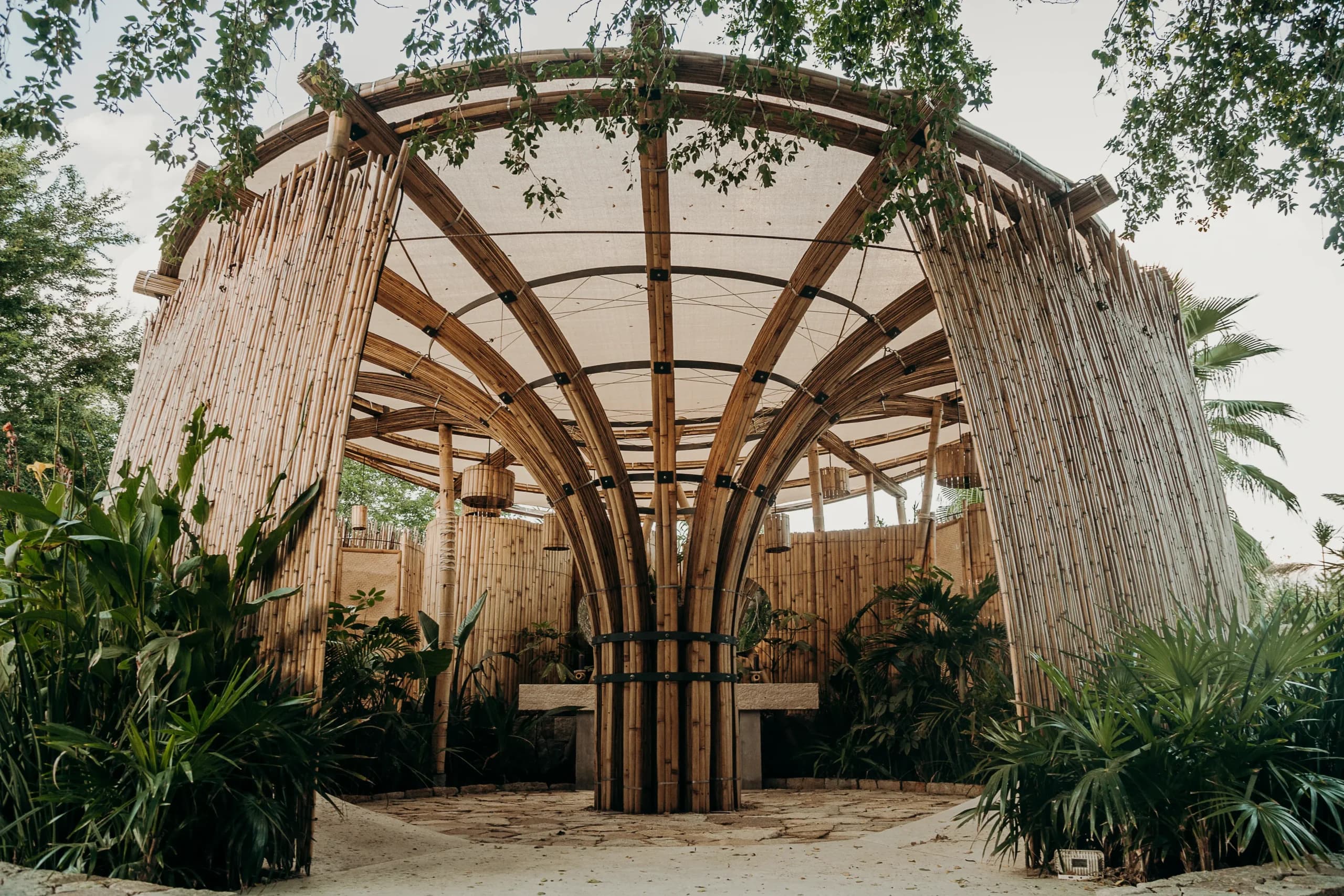
Bamboo in Desert Architecture: When It Works and When It Doesn't
Bamboo has a strong presence in natural architecture circles, and for good reason — it's one of the fastest-growing natural building materials on earth, with tensile strength comparable to steel in certain applications, excellent carbon sequestration during its growth cycle, and a visual warmth that no manufactured material replicates.
But bamboo is also frequently misunderstood in terms of climate compatibility. Most of what's written about bamboo construction comes from tropical and subtropical contexts — Indonesia, Colombia, Costa Rica, parts of southern China — where the material's primary challenge is keeping it dry. The design strategies and material treatments appropriate for those climates don't transfer directly to BCS.
I've worked with bamboo in several projects here. Here's what I've learned about when it works and when it doesn't, and why the approach has to be different in a desert coastal environment.
Why bamboo in BCS is a different conversation
Baja California Sur presents bamboo with three simultaneous stressors that don't occur in tropical settings:
UV radiation. At this latitude and altitude, UV exposure is extreme. Untreated bamboo exposed to direct sunlight in BCS will begin losing its color within weeks, develop surface checking (longitudinal cracks) within months, and have significant structural degradation within two to three years. The organic compounds in bamboo's outer surface break down under sustained UV faster than in humid tropical environments, where cloud cover and plant canopy reduce direct exposure.
Coastal salt aerosol. Properties within 5km of the Sea of Cortez are in an aggressive salt environment. Salt particles carried by prevailing winds land on surfaces and accelerate oxidation of the silica in bamboo's outer culm, reducing natural durability. This is the same mechanism that attacks steel, concrete finishes, and wood — but bamboo, being organic, reacts differently than these materials.
Diurnal temperature swings. The BCS desert can see 20°C of temperature variation between peak afternoon and pre-dawn temperatures. Materials that expand and contract through that range repeatedly experience stress at their joints, connections, and surface treatments. Bamboo's natural tendency to check (crack along its grain) is amplified in environments with large thermal cycling.
None of these problems are disqualifying — but they are the design brief. If you ignore them, bamboo in BCS fails fast and expensively. If you address them directly, bamboo can perform for decades.
Treatment protocols for BCS conditions
The baseline for any bamboo used in exterior applications in BCS is a treatment protocol that goes beyond what you'd use for temperate or humid tropical contexts.
Borax-boric acid treatment (preventive)
This is the standard natural treatment for bamboo against insect attack (particularly the bamboo borer beetle, Dinoderus minutus, which is present in Mexico) and fungal decay. For BCS, it's necessary but not sufficient — it addresses biological threats but not UV or thermal stress.
The process involves soaking freshly harvested culms in a solution of borax and boric acid in water, allowing the solution to penetrate the vascular bundles of the culm. This must be done shortly after harvest, when the bamboo's moisture content is high enough to allow absorption. Dried, seasoned bamboo resists impregnation.
UV-stabilized exterior coatings
After borax treatment and thorough drying (bamboo must be dried slowly to a stable moisture content — rushing this process causes cracking), exterior bamboo in BCS needs a UV-stabilized penetrating finish. I've tested several products in projects here. What works consistently is a penetrating oil-based exterior finish with UV absorbers, applied in 2–3 coats, with annual or biannual reapplication for pieces in full sun.
Do not use film-forming varnishes or polyurethane on exterior bamboo in BCS. The thermal cycling causes the film to lift at the culm's natural checking points, creating pockets where moisture gets trapped and decay accelerates.
Charring (Shou Sugi Ban principle)
The Japanese technique of surface charring, applied to bamboo instead of wood, creates a carbonized outer layer that is naturally UV-resistant, repels insects without chemical treatment, and has a dramatic aesthetic. This works in BCS for specific applications — decorative screens, accent elements, feature columns — but not for structural bamboo where the charred surface would obscure inspection for cracks or structural issues.
Species: not all bamboo is appropriate for construction
There are over 1,400 species of bamboo. In architectural applications, a handful have been validated for structural use. In the BCS context, the relevant species are:
Guadua angustifolia — The Colombian giant bamboo, the gold standard for structural bamboo construction in the Western Hemisphere. Guadua has exceptional tensile and compressive strength, large culm diameter (10–20cm in mature specimens), thick culm walls, and good natural silica content that provides some inherent UV resistance. This is the species used in serious bamboo construction in Mexico and Central America. Importation from Jalisco and Michoacán growing regions or from specialty suppliers in Mexico.
Phyllostachys edulis (Moso) — Widely grown in Mexico, very large culms. Excellent structural properties. Available through nurseries and growers in several Mexican states. Compatible with BCS applications when properly treated.
Dendrocalamus asper — A tropical giant bamboo from Southeast Asia that has been introduced in several tropical Mexico growing regions. Very large culms, excellent for heavy structural applications. Requires complete treatment protocol for BCS.
What to avoid: Unidentified bamboo from local markets or nurseries that may be ornamental species with thin walls and low structural capacity. Also avoid bamboo sold as "naturally preserved" or "kiln-dried" without documentation of the specific treatment process — the claims are often marketing rather than a validated preservation protocol.
Where bamboo works well in BCS architecture
Given the constraints above, there are specific applications where bamboo genuinely excels in the BCS context.
Covered structural elements (roof structure, internal columns)
Protected from direct sun and rain, bamboo performs beautifully as a structural material. A bamboo pole roof system under a palm thatch or solid roof covering can last 20–30+ years with minimal maintenance. The material works in compression and in triangulated structural systems very effectively, and the visual quality — the nodes, the slight irregularity of natural poles, the warmth of the color — is something no manufactured material replicates.
In projects like Puerto Raiz, where indoor-outdoor structures bridge the boundary between enclosed and open space, covered bamboo column and beam systems provide structural performance and create a spatial character that connects the building to the BCS vernacular — the ramada, the palapa, the shade structure that has been used in this landscape for centuries.
Interior applications
Inside, removed from direct UV exposure, properly treated and finished bamboo performs excellently in BCS. Bamboo flooring, bamboo wall cladding panels, custom furniture, and millwork all work well in interior conditions. The primary consideration inside is humidity management: BCS coastal zones can see rapid swings between dry desert air (relative humidity 20–30%) and humid tropical air during summer moisture events (RH 70–80%). Bamboo products with proper moisture stabilization and clear documentation of their manufacturing process handle this better than artisanal or improperly dried material.
For flooring specifically, strand-woven bamboo is more dimensionally stable than traditional horizontal or vertical laminated bamboo and better suited to BCS's humidity variation.
Outdoor covered spaces (palapa-style structures)
The traditional palapa — an open-sided structure with a bamboo or palm thatch roof — is an indigenous technology refined over centuries for exactly this climate. Bamboo poles as structural columns under a thatched roof, in a structure that provides shade while remaining well-ventilated, are in their ideal application context. The structure is simple, repairable with local skills, and directly continuous with BCS vernacular building culture.
Decorative screens and facades (with caveats)
Exterior screens and facade elements in bamboo can work in BCS if the material is treated, if the design allows for air circulation (which helps the material dry after rain), if the orientation avoids full-afternoon-sun exposure, and if there is a maintenance schedule built into the project. A bamboo screen on a south or west facade without UV protection will look tired within three years. The same screen on a north-facing exterior wall, treated and maintained, can hold its quality for a decade.
Where bamboo fails in BCS
Ground contact. Bamboo in contact with soil in BCS fails rapidly due to the combination of termite activity (subterranean termite populations are significant here), moisture wicking through the culm base, and salt in coastal soils. Any structural bamboo column must be elevated above grade with a concrete base or a corrosion-resistant metal shoe connector.
Untreated exterior exposure. I've seen projects in BCS where bamboo was specified for its look without any treatment protocol. The visual deterioration and structural degradation within two to three years is significant. Bamboo in BCS without treatment is not a low-maintenance natural material — it's an expensive problem.
Flat roof or horizontal exterior applications. Bamboo laid horizontally as an exterior deck or pergola slat collects water in its internodal cavity (bamboo culms are hollow between nodes), which accelerates interior decay that's invisible from outside. Horizontal exterior bamboo must have end caps to prevent water entry or be specifically cut to allow drainage.
How we use bamboo at Symbiotica
At Symbiotica, we use bamboo selectively and specifically — not as a default natural material but as a material with a defined role in each project.
We use it where it contributes structurally or spatially in ways that other materials can't match: roof structures under thatch, interior feature elements, outdoor covered terraces. We treat every piece to BCS-specific standards before installation. We build in a maintenance schedule and communicate it clearly to the client.
The goal is bamboo that lasts twenty years rather than bamboo that looks good for a season. BCS is a demanding environment. Every material decision has to start from that fact.
Schedule a free consultation → info@symbioticarq.com
Symbiotica
Ready to start your project?
Free 60-minute consultation — no commitment required.