

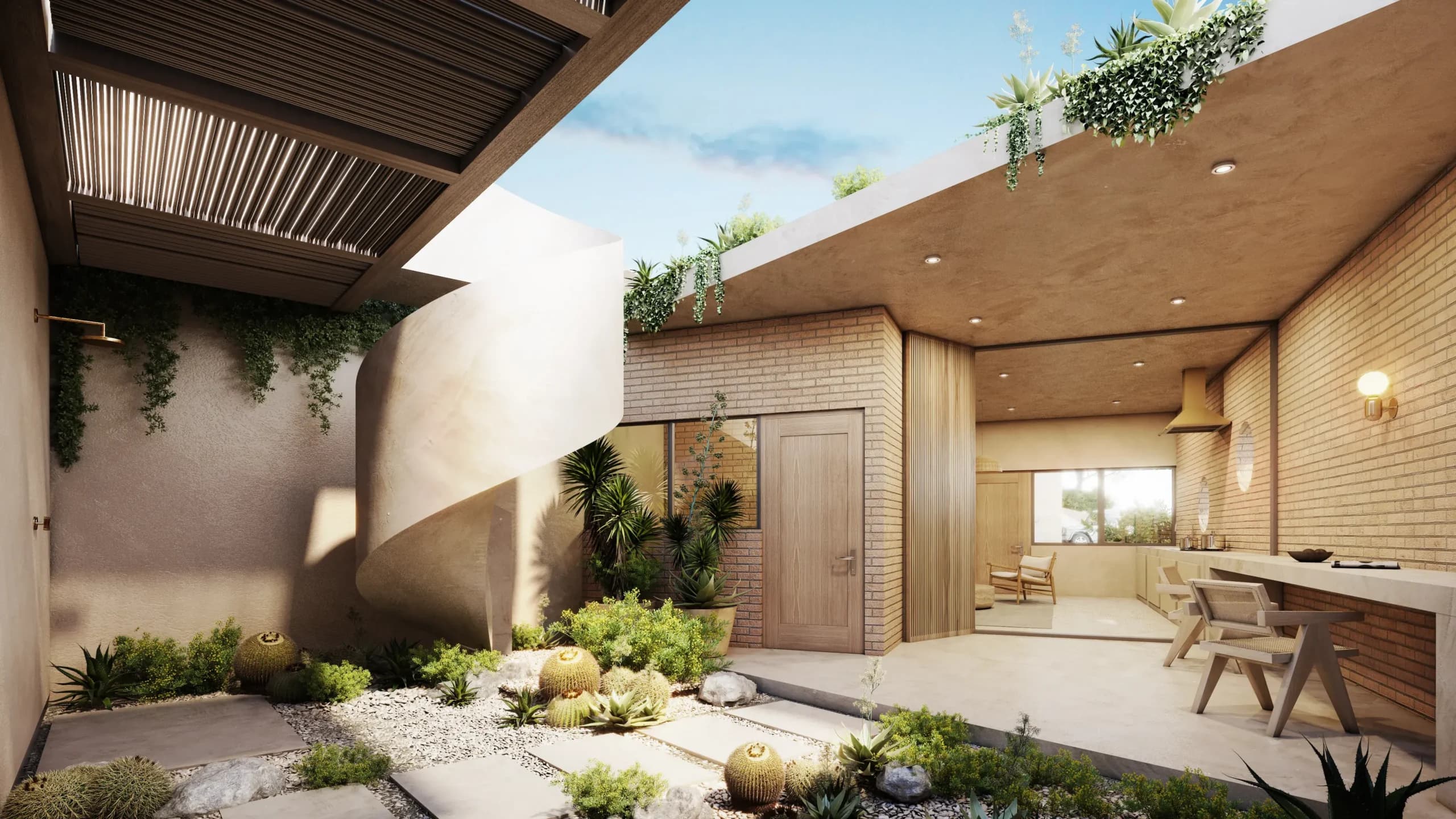
Building vs. Buying in Los Cabos: A Real Comparison
This is the question I get asked more than almost any other, usually by clients who've already looked at the resale market in Los Cabos, found either nothing they like or nothing at their price point, and are now wondering whether building is the better path.
The honest answer is: it depends on things that are specific to your situation. But I can give you the real comparison — not the version designed to push you toward one option.
I'm an architect, so you might expect me to recommend building. I recommend whichever option genuinely serves the client better, and sometimes that's buying. Here's the framework I use when I work through this with people.
What the market actually looks like right now
The Los Cabos residential resale market has compressed significantly over the past four years. Inventory in desirable zones (the Corridor, East Cape, Todo Santos area) is low, prices have risen substantially since 2020, and the days of finding an undervalued property with good bones and a great lot are fewer than they were.
What's available tends to fall into a few categories:
Turnkey luxury resale — Fully finished homes in gated communities, typically $600K–$3M USD. High quality finish, often furnished, ready for occupancy. The drawback is that these are built to a developer's design brief, not yours. They tend toward a certain aesthetic (high ceilings, stone floors, infinity pool, neutral palette) that works for vacation rental income but may not be the home you'd design for yourself.
Fixer-uppers and older construction — Properties in the $300K–$600K range that need significant work. These are where the equation gets complicated. Mexican residential construction from 2000–2015 in BCS frequently has issues: undersized electrical systems, inadequate waterproofing, minimal insulation (sometimes none), conventional concrete block construction with no thermal management. Buying one of these and renovating to contemporary performance standards can easily cost 60–80% of the purchase price on top of acquisition cost.
Land with permits — A useful middle option: buying a lot that already has architectural plans approved and permits in process or in hand. This cuts 3–6 months off a build timeline and eliminates permitting uncertainty, at the cost of being committed to someone else's design unless you're willing to restart that process.
The real cost of building in BCS
I want to give you real numbers rather than the theoretical ones that appear in marketing materials.
Construction costs in Los Cabos as of 2026 range from $1,200 to $2,500+ USD per square meter of built area, depending on specification level, site accessibility, and current material costs.
That translates to:
- Entry-level construction (concrete block, conventional finish, minimal passive design): $1,200–$1,500/m²
- Mid-range quality (good materials, passive ventilation design, proper detailing): $1,500–$1,900/m²
- High specification (natural materials, bioclimatic design, custom details, high-performance systems): $2,000–$2,500/m²
A 150m² home at mid-range specification costs approximately $225,000–$285,000 USD in construction. Add land purchase ($100K–$500K depending on location and size), architect and engineering fees (typically 12–18% of construction cost), permits and legal costs ($8,000–$20,000 depending on the municipality and project complexity), and you arrive at a total project cost.
What this comparison looks like in practice:
For a $600,000 USD budget:
- Buying: You're in turnkey resale territory in many parts of the Corridor. You get what's there, quality and design as-is.
- Building: You might spend $200K on a good 1,000m² lot in an emerging zone, $270K on construction of a thoughtfully designed 160–170m² home at good specification, and $50K on fees, permits, and finishing details. That leaves contingency and furnishing budget.
The built option gives you more control, a more efficient building (thermally and operationally), and something designed specifically for your use — for roughly the same total investment.
Timeline: the honest version
Building in BCS takes longer than most clients anticipate when they start the process.
Realistic timeline from first meeting to occupancy:
| Phase | Duration | |---|---| | Site analysis, programming, concept design | 4–6 weeks | | Schematic design through final construction drawings | 8–14 weeks | | Permit application and approval | 6–18 months (highly variable by municipality and project) | | Construction | 12–18 months for a typical residence | | Total | 22–36 months from project start |
The permit phase is the biggest variable. In some municipalities within BCS, straightforward residential projects on compliant lots move through in 3–4 months. In others, with ejido land complications, environmental review requirements, or backlogged municipal offices, 12–18 months is realistic.
Buying an existing property — from signed offer to closing typically takes 45–90 days in a straightforward transaction, assuming clear title and no title issues (more on that below). You can be in a finished, furnished home within three to four months of deciding to buy.
If your timeline requires occupancy within 12–18 months, buying is more reliable. If you have 24–36 months and want something designed specifically for your life and the climate, building is worth the wait.
The title and land question for foreigners
This is critical and I want to address it directly because it affects the building vs. buying comparison differently than most people expect.
In Mexico, foreigners cannot directly own land within 50km of the coast or 100km of an international border — this is the Restricted Zone, and it covers essentially all of Los Cabos. Foreigners instead hold property through one of two structures:
Fideicomiso (bank trust): The land is held in trust by a Mexican bank, with the foreign buyer as the beneficiary with full rights to use, sell, rent, and modify the property. Annual trust fees run $500–$800 USD/year. This is the standard structure for foreigners buying property in BCS and is fully legal and well-established.
Mexican corporation (S.A. de C.V. or SAPI): Property held by a Mexican company in which the foreigner is a shareholder. Used more often for commercial properties or large residential investments where the corporation structure has additional advantages.
Both structures work for building and buying. The relevant point is that when buying existing property, you need a thorough title check — especially for properties that were part of ejido land that was converted to private title. Title issues in BCS are not uncommon and can be costly to resolve. Work with a notario experienced in foreign buyer transactions and get a title insurance policy (available in BCS through several providers).
When building on a new lot, you start with a clean title history (assuming your attorney has checked it thoroughly before purchase) and no historical ownership complications to unravel.
Customization: what you actually gain by building
This is where the building case is strongest for a certain type of client.
A home designed specifically for BCS conditions will outperform a spec-built resale in several measurable ways:
Thermal performance — A bioclimatic design with correct orientation, passive ventilation, and thermal mass will run 50–70% less air conditioning than a conventionally built home. Over a 10-year ownership period in a vacation rental context, that's a meaningful difference in operating cost and a significant selling point for guests who pay attention to energy consumption.
Water efficiency — A designed water system with rainwater harvesting (BCS gets concentrated rainfall during tropical season), greywater reuse, and xeric landscaping can reduce water consumption by 40–60% compared to a conventional property. Again, this matters both economically and in the context of BCS's water scarcity.
Spatial fit — If you know how you live — you work from home and need a real home office, or you entertain frequently and need a kitchen-to-outdoor flow that most spec houses don't have, or you want to sleep in a room that catches the morning sea breeze — only a custom-designed house will give you that.
Rental performance (if applicable) — Thoughtfully designed homes with distinct architectural character and outdoor spaces that work in the BCS climate consistently outperform generic luxury finish in the vacation rental market. Guests notice design. Architecture that belongs to its landscape photographs differently from a house that could be anywhere, and in a market as visual as vacation rental, that difference shows in nightly rates.
When buying makes more sense
Building is not always the right answer. I'll be direct about when I'd advise a client to buy rather than build.
You need certainty of timeline. Life situations — relocating for work, wanting to be in residence by a specific date, a health situation — sometimes make the predictability of buying non-negotiable. Building has too many variables in BCS to promise an occupancy date.
Your budget is below $400K total. At this level, land + construction + fees leaves very little margin for the cost overruns that are essentially guaranteed in BCS construction. A well-priced existing property may genuinely be better value.
You found a lot that doesn't work for building. Not all BCS lots are buildable at reasonable cost. A lot with severe slope, poor access, no utility easements, or title complications may be far cheaper to walk away from than to resolve. Existing construction on a problematic lot has already absorbed those costs.
You want something now. There is real value in being able to furnish and occupy a property immediately rather than watching a construction site for two years. If using the property in the near term is important to you, that value is real and should factor into the comparison.
The hybrid option: buy land with existing structures
There's a middle path I see underutilized in BCS: buying a lot that already has some construction — often an older, modest structure — and using that structure as the seed of a new design.
The existing structure can serve as temporary accommodation during construction, as a guest casita, or as storage. The lot comes with established utilities and often with pre-existing site clearance. Depending on the municipal context, you may be able to build an addition rather than a full new project, which in some cases simplifies permitting.
This isn't always better than buying raw land or a turnkey property — but it's worth evaluating when you find a lot with a great position and a modest existing structure that makes the land more affordable than comparable vacant lots.
The right answer depends on your specific timeline, budget, use case, and tolerance for process. What I can tell you is that a well-designed new build in BCS, done correctly, will serve you for decades and perform better than anything built without a climate strategy. If you're willing to invest the time, it's usually worth it.
Schedule a free consultation → info@symbioticarq.com
Symbiotica
Ready to start your project?
Free 60-minute consultation — no commitment required.