

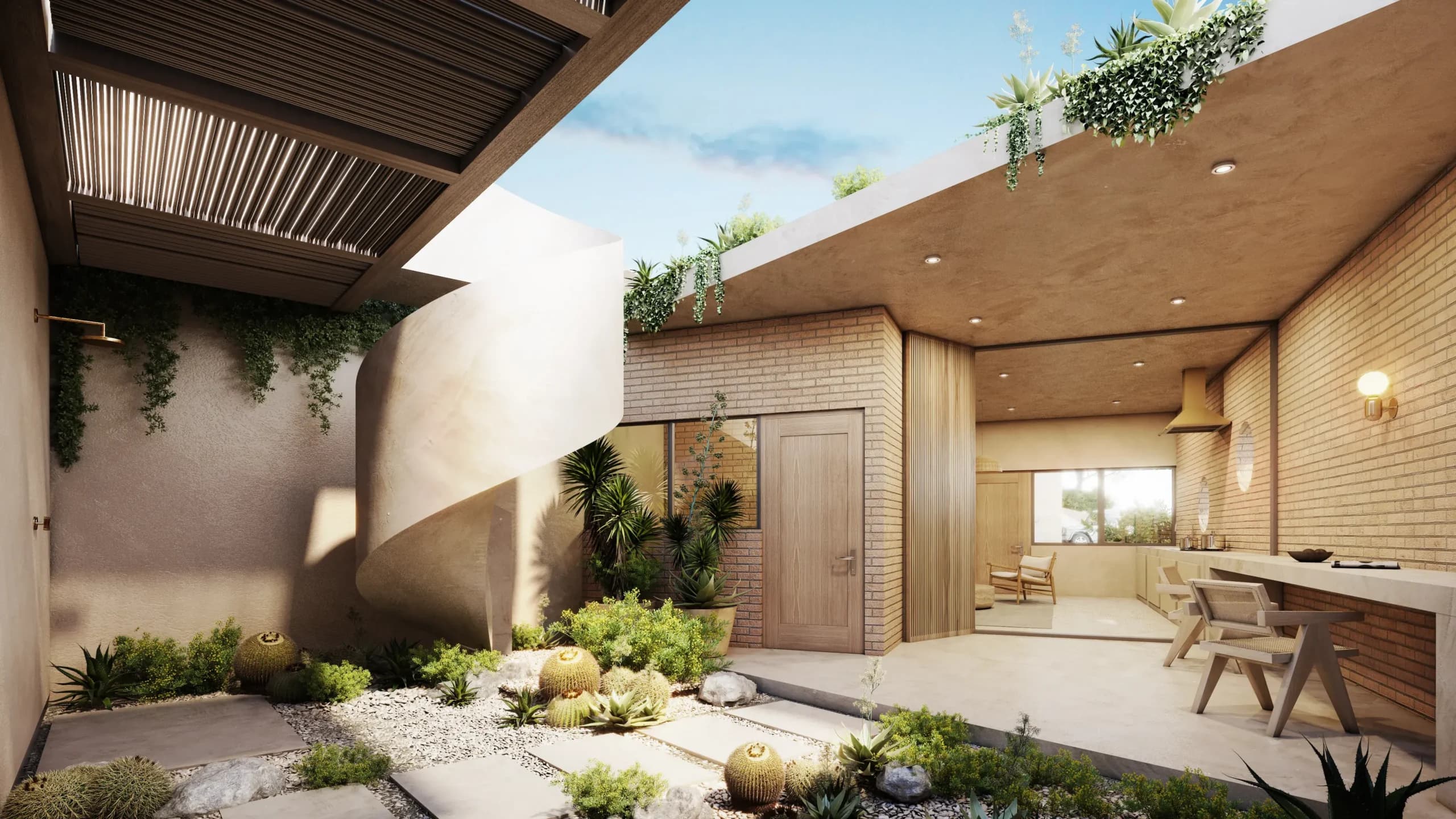
What Makes a Luxury Home in Los Cabos Genuinely Sustainable (and What Doesn't)
There is a version of "sustainable" in Los Cabos real estate that means bamboo floors and a brochure mention of solar panels. And then there's the actual thing — a building that uses meaningfully less water, energy, and materials than a conventional alternative, that is more comfortable to live in because it works with its climate rather than fighting it, and that can demonstrate its performance over time.
The distinction matters because Los Cabos is a market where luxury clients are spending $1M–$5M+ on residential projects. At that investment level, you have both the budget to do sustainability correctly and the risk of having it done as a performance rather than as an engineering commitment.
I'm going to be specific about what's real and what isn't.
What greenwashing looks like in this market
These are genuinely common in high-end Los Cabos projects. They're not necessarily dishonest — they may be elements of a broader sustainable package — but they're frequently cited as proof of sustainability without supporting evidence.
"Solar panels included." A 2 kWp solar system on a 500 m² mansion with four HVAC zones and a heated pool is not a meaningful sustainability measure. The system offsets perhaps 10–15% of the actual electrical load. It's a sustainability checkbox, not a sustainability strategy.
"Low-flow fixtures." Low-flow faucets and showerheads reduce water use at the point of delivery, which is real and meaningful. But a home with a 200 m² pool, irrigated tropical landscaping in a desert, and six bathrooms that are each supplied by a private well drawing from an overexploited aquifer is not a water-responsible project.
"Natural materials." The use of wood, stone, or natural fiber in a luxury home is aesthetically appropriate and often beautiful. But wood imported from tropical forests, stone shipped from Europe, and natural fiber from halfway around the world with significant transport emissions is not inherently more sustainable than well-sourced regional materials. The provenance and the supply chain matter.
"LEED-inspired design." This phrase, which appears in actual marketing materials, means neither LEED certified nor LEED registered — it means the designer was aware that LEED exists.
"Bioclimatic design." This term is widely used in BCS real estate and architecture marketing. Actual bioclimatic design produces measurable outcomes: quantified reduction in cooling loads, specific passive strategies with calculated performance, verified thermal comfort metrics. Without these, it's a word.
Passive design: the non-negotiable foundation
If a luxury sustainable home does nothing else correctly, it has to get passive design right. Passive design is the starting point, not the supplement — because every sustainable systems decision (solar sizing, water system design, mechanical system specification) depends on what the building envelope is doing.
Orientation. In BCS, the dominant sustainable orientation strategy is:
- Long facades perpendicular to the northwest prevailing wind (for cross-ventilation)
- Minimum west facade exposure (the west elevation receives the most intense heat load from 1–6pm)
- South facade shading with overhangs calculated for the BCS solar angles (approximately 23°N latitude)
A luxury home oriented for a view without considering these factors can easily add 40–60% to the annual cooling load compared to a climate-correct orientation. Views can often be captured from the east or southeast — from a covered terrace, from a high clerestory, from a framed window rather than a full glass wall. View orientation and climate performance are not always in conflict; they require careful choreography to achieve both.
Thermal mass and insulation. The Los Cabos climate is hot and dry with daily temperature swings of 15–22°C between midday and pre-dawn in summer. This diurnal swing is the resource that thermal mass captures.
A luxury wall assembly we use: compressed earth blocks (40 cm), exterior lime-sand render, interior chukum finish. This assembly has a thermal lag of 10–14 hours and a U-value of approximately 0.7 W/m²K. Compare to a typical high-end concrete masonry block wall at 20 cm with stucco (U-value ≈ 3.2 W/m²K, thermal lag ≈ 3 hours). The earthen assembly stores five times more heat and releases it on a time cycle that aligns with natural temperature rhythms.
Shading devices calculated, not estimated. Overhang depth is math. At 23°N, the sun altitude at solar noon on the summer solstice is approximately 90° − 23° + 23.5° = 90.5° (essentially overhead). The required overhang depth to shade a window fully at that angle is tiny. But the critical design condition is not the solstice noon — it's the afternoon, when the sun is still high but has moved west, and heat gain in west-facing rooms drives air conditioning use for the rest of the evening.
We calculate shading performance for each facade using solar geometry tools and specify overhang dimensions, pergola spacing, and shading device geometry to achieve specific solar heat gain coefficient targets. This is engineering, not guesswork.
Water: where luxury consumption most often goes wrong
The median luxury home in Los Cabos has a water consumption profile that is incompatible with the peninsula's hydrology. Pools, irrigated tropical gardens, multiple daily guest turnover in high-end rentals — these create per-household water demands that would be significant even in a water-rich climate. In a region drawing down its aquifer, they're genuinely problematic.
What a genuinely water-responsible luxury home looks like:
Pool design matters. A 50,000-liter pool with no cover loses 3,000–5,000 liters per month to evaporation in BCS. A covered pool, or a pool with a foam bubble cover used during non-swimming hours, reduces evaporation loss by 80–90%. An infinity pool — dramatic as it is — requires a balance tank and continuous pump operation that adds to both water and energy consumption. Pool design decisions have real water implications.
Native or adapted landscape. The cardón, torote, palo verde, agave, and other endemic species of BCS are spectacular. A designed landscape using these species requires zero irrigation once established (after 1–2 years). A landscape of tropical species — palms, tropical flowers, lawn — requires continuous irrigation equivalent to 500–1,000 liters per 100 m² per day in summer. The difference between these two landscape strategies in a 2,000 m² property can be 30,000–60,000 liters per month.
Rainwater and greywater systems. For a luxury home in BCS, these should be standard, not optional. A full rainwater harvesting system with a 30,000–50,000-liter cistern and a greywater treatment and reuse loop can offset 20–40% of total water demand depending on household size and water use profile. In a $3M home, the cost of these systems (USD $15,000–30,000) is a rounding error.
Energy: the honest accounting
A luxury home in BCS that operates conventionally — air conditioning all rooms all day, heated pool, landscape lighting, high-output kitchen equipment, media rooms — can easily consume 100–150 kWh/day in summer. Sizing a solar system to cover that load requires 20+ kWp of panels and, if off-grid, a battery bank in the $80,000–120,000 range.
The more rational approach: design the building to reduce the load first, then size the solar system to cover the reduced load. A passively designed home of the same size might consume 25–40 kWh/day in summer — 60–75% less — and can be covered with a 6–8 kWp grid-tied system.
The passive design investment and the solar investment are complements, not alternatives. But the sequence matters: passive first, then solar.
Materials: local, traceable, honest
In a luxury project, there's budget for premium materials. The question is whether that budget is used for premium imported materials that have no relationship to the place, or for locally sourced and artisan-produced materials that carry the quality of this territory.
Local volcanic stone from BCS arroyos and quarries — for walls, flooring, and exterior paving. This material is available at lower cost than imported stone, requires no freight, and creates an immediate visual connection between the building and its landscape.
Adobe and tapial — compressed earth from on-site or regional sources, thermally superior to any imported wall system, processed by local masons, zero transport emissions.
Chukum — applied by artisans who know the material, from sustainable bark harvest in Yucatán. The craftsmanship is premium; the chemistry is pre-Hispanic; the result is unique.
Regional hardwoods from certified sources — madera de construcción from certified forests in mainland Mexico, specified with FSC documentation. Not imported teak or endangered tropical species.
Locally fabricated metalwork — iron, steel, and copper details made by local artisans in Los Cabos or La Paz. These carry a quality of handwork that imported catalog metalwork doesn't.
The luxury of genuinely sustainable materials in BCS is the luxury of place — materials that are specific to this territory and cannot be replicated in a project elsewhere. That is a more genuine form of exclusivity than imported marble from a quarry thousands of kilometers away.
Certifications: useful but not sufficient
LEED, EDGE, BREEAM, and Living Building Challenge are all valid frameworks with legitimate value. In BCS, LEED certification (typically New Construction or Homes) is the most common formal sustainability standard pursued by high-end projects.
My honest view: LEED certification is useful as a process discipline — the documentation requirements force attention to energy modeling, material sourcing, and water management that might otherwise be skipped. But LEED certification is not the same as excellent sustainable design. A building can be LEED certified and be a mediocre performer in the specific conditions of BCS. A building can be uncertified and outperform LEED Platinum in actual occupant comfort and resource efficiency.
Certification is a proxy. Performance is what matters. If your architect can show you energy consumption data from completed projects in BCS — actual measured kWh/m²/year — that's more meaningful than a certificate.
We pursue certifications when clients want them, and we think they add value as process structure. We don't use them as a substitute for the actual design work that produces performance.
Schedule a free consultation → info@symbioticarq.com
Symbiotica
Ready to start your project?
Free 60-minute consultation — no commitment required.