

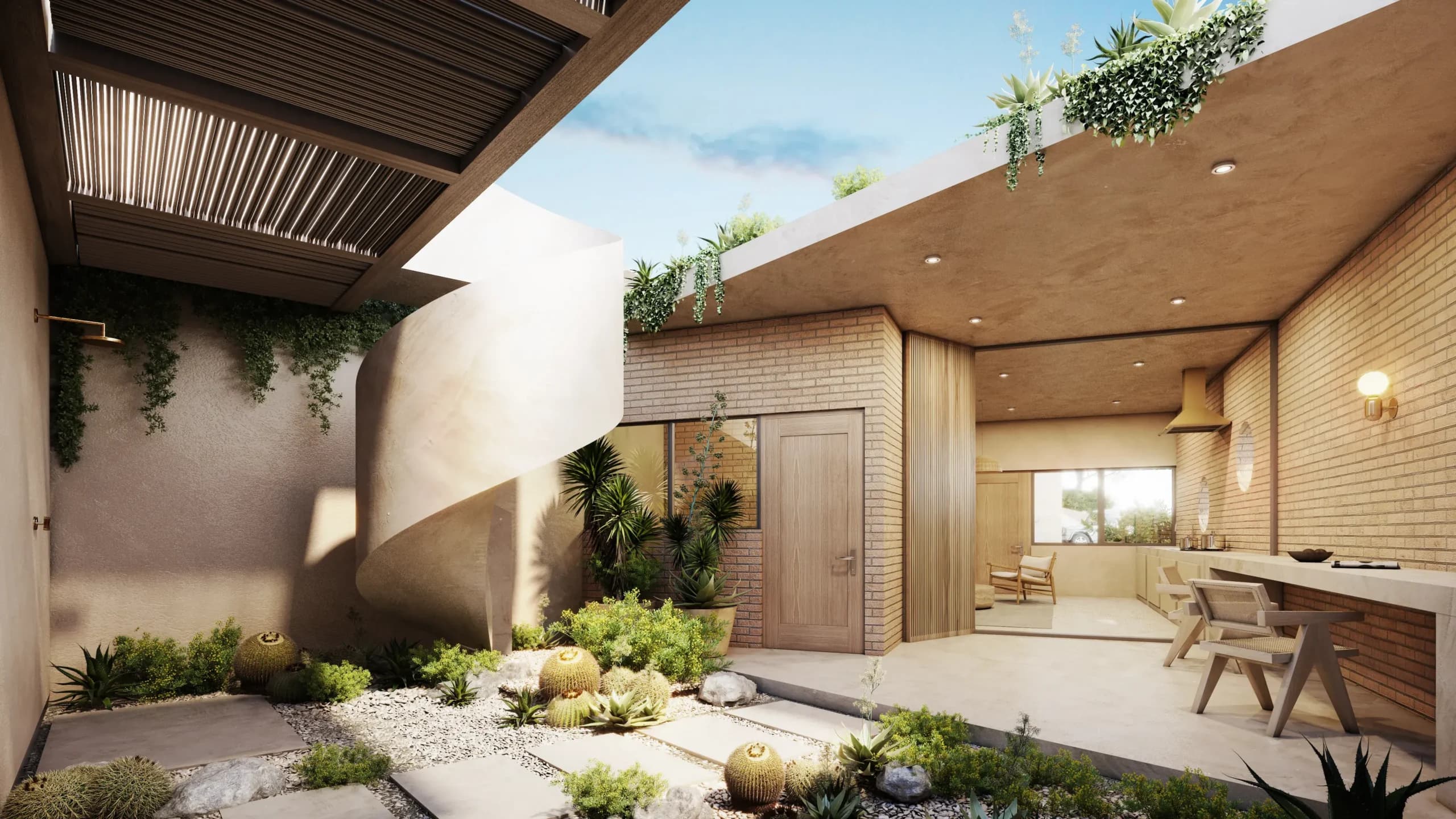
Volcanic and Sedimentary Stone in BCS Architecture: A Material Guide
One of the things that defines Baja California Sur as a geological landscape is the variety and quality of its stone. The peninsula is formed primarily by volcanic and metamorphic rock — granite batholiths in the Sierra de la Laguna, dark basaltic formations in the coastal ranges, pale andesite and rhyolite in the volcanic fields north of Los Cabos, sedimentary limestone and travertine formations in certain coastal zones.
This variety means that almost every lot in BCS has some form of local stone either on the surface or immediately below it. When I do a first site visit, one of the things I'm always looking at is the ground — what color is the rock, what's the texture, how does it fracture, and is there enough of it to potentially incorporate into the building.
Using local stone is one of the strongest design decisions you can make in BCS for reasons that are simultaneously aesthetic, thermal, ecological, and economic. Here's how I think about it and how we work with it at Symbiotica.
The geology of Los Cabos: what you're working with
Understanding the stone of BCS requires a quick geography lesson, because the material varies significantly by location and that variation matters for construction.
Sierra de la Laguna and foothills (granite/gneiss)
The backbone of the southern cape is composed of a large granitic batholith — ancient igneous rock, very hard, very dense, and in certain zones showing spectacular coarse crystal structure. Granite from this region ranges from pale grey to pink-grey depending on mineral composition. It has high compressive strength, excellent durability in exterior applications, and thermal mass values that make it one of the best passive cooling materials available.
Granite from BCS quarries and surface outcrops is used in our projects as wall building material (stacked or mortared), as floor paving (cut to flags), and as feature elements — entry thresholds, bath platforms, fireplace surrounds. It's a heavyweight material in every sense: dense, permanent, and visually serious.
Volcanic fields (basalt, andesite, rhyolite)
North of the Cabo Corridor and in several zones in the municipality of Los Cabos, there are volcanic formations producing dark basalt and lighter andesite. Basalt is the rock you see in the characteristic black lava formations visible in many BCS landscapes — the dark, often scoriaceous (vesicular) rock with a cooling history you can sometimes read in the texture of the surface.
Basalt has exceptional hardness (it scores 7–8 on the Mohs scale), very good UV resistance (dark minerals are stable under solar exposure), and excellent thermal mass properties. Its limitation in some applications is that it's more difficult to cut cleanly than granite or limestone — the vesicular texture of some basalt formations means it fractures unpredictably. Good stone cutters in BCS have developed techniques for working specific local formations, and sourcing from a cutter who knows the material is important.
Andesite and rhyolite from BCS volcanic fields are lighter in color and somewhat softer than basalt. These materials cut and dress more easily, making them useful for applications requiring precise dimensioning — window surrounds, step nosings, carved elements.
Sedimentary formations (limestone, travertine, sandstone)
In certain coastal and near-coastal zones, particularly in the northern parts of the municipality and in some arroyo systems, there are sedimentary stone deposits including calcareous limestone and travertine. These are lighter in color (cream, warm tan, pale orange-yellow), softer than volcanic rock, and often have layered or fossiliferous texture.
Sedimentary stone from BCS is beautiful in certain interior and semi-exterior applications — floor paving in covered outdoor areas, bathroom finishes, interior feature walls. Its limitations in exterior exposure are real: softer sedimentary stone is more susceptible to salt aerosol erosion in coastal zones and requires a penetrating sealer for horizontal applications where pooling water can cause surface spalling over time.
Thermal mass: why BCS stone is a passive cooling strategy
This is the performance argument for local stone that goes beyond aesthetics.
Thermal mass refers to a material's ability to absorb, store, and release heat slowly. A material with high thermal mass acts as a thermal buffer: during the day, it absorbs heat from the environment (solar radiation, hot air), warming up gradually. At night, as the environment cools, it releases that stored heat.
In BCS, with day-night temperature differentials of 15–20°C in inland and elevated sites, thermal mass is a primary passive cooling strategy. A thick stone or earthen wall:
- Delays the peak interior temperature by 6–12 hours relative to the exterior peak
- Reduces the amplitude of interior temperature variation (the difference between daily high and daily low inside the building)
- Creates a fly-wheel effect: by morning, the mass has released the previous day's heat and is cool again, ready to absorb another day's load
Practical thermal mass values for BCS stones:
| Material | Density (kg/m³) | Specific heat (kJ/kg·K) | Thermal mass rating | |---|---|---|---| | Granite (BCS) | 2,650–2,750 | 0.79 | Very high | | Basalt (BCS) | 2,700–3,000 | 0.84 | Very high | | Limestone | 2,100–2,700 | 0.84 | High | | Concrete block (standard) | 1,800–2,100 | 0.84 | Medium |
Granite and basalt from BCS outperform standard concrete block by 25–50% in terms of thermal mass per unit volume. A 400mm thick granite or basalt wall stores and releases significantly more heat than a 200mm concrete block wall — which is the standard construction in most speculative residential development in the region.
The wall has to be thick to work. Thin stone cladding on a lightweight structure provides the visual aesthetic of stone but essentially none of the thermal performance. This is a common greenwashing pattern in residential development — a 30mm stone veneer over concrete block does nothing for thermal mass.
Where stone gets sourced
This is the practical information that makes the material decisions real.
Surface stone from the lot itself — In many BCS lots, particularly on slopes and in arroyo-adjacent positions, there is significant surface stone that has to be cleared for construction regardless. When this stone is appropriate (not too friable, not too irregular for construction use), incorporating it into walls, terraces, and site elements is the most local and lowest-impact material sourcing possible. We routinely ask clients whether we can use lot clearing stone before buying from a quarry. The logistical coordination adds some complexity but the result — a building made of its own ground — is architecturally very powerful.
Local quarries and canteras — There are active stone cutting operations in several locations within BCS and adjacent Baja California Norte. For dimensioned stone (flags, blocks, veneer panels), a local cantera provides consistent dimension and surface treatment. Costs are significantly lower than imported stone for the same quality level, and the material has the specific color and texture of the landscape.
Reclaimed and salvage stone — There is a market in BCS for salvaged stone from demolitions, old walls, and cleared agricultural land. Reclaimed stone has an authenticity of surface — the weathering, the irregular cut, the evidence of previous use — that new stone doesn't have. For certain projects and certain clients, it's worth the effort of sourcing.
What I don't use: Imported marble or granite from Querétaro or from international suppliers where BCS-local stone achieves the same or better performance for a fraction of the carbon footprint and transport cost. I've been asked for Calacatta marble in a BCS bathroom multiple times. My answer is always the same: I understand the aesthetic, but look at what the local limestone can do in the same application, at a third of the cost, from a quarry forty minutes away.
Applications in construction
Load-bearing stone masonry walls
In single and two-story residential construction, stone masonry walls are fully viable as structural elements in BCS. Random rubble masonry (fieldstone in mortar) or coursed ashlar (dressed stone in regular courses) can carry vertical loads safely when properly designed and constructed.
The key engineering requirements: a proper foundation sized for the wall weight (stone is heavy — a 400mm granite wall has a dead load of roughly 2,600 kg per linear meter per floor height), horizontal reinforcement at regular intervals to resist seismic lateral loads (BCS has seismic activity and building codes require earthquake engineering), and mortar that is compatible with the specific stone being used.
Stone masonry walls in BCS should use a mortar of Portland cement + lime + local sand in proportions that produce a mortar slightly softer than the stone. This is counterintuitive to construction workers trained on standard concrete construction — the instinct is to use strong mortar. But hard mortar in soft stone forces cracks through the stone rather than through the joint, causing irreparable damage. The mortar is the sacrificial element.
Floor paving
Stone floors in BCS work beautifully in interior, semi-exterior, and exterior applications. In interior use, stone's thermal mass effect is most useful when the floor is in contact with the ground (slab on grade) or when there is a gap between the structural floor and the stone that allows thermal exchange with the ground below.
For outdoor terraces, the key specifications are:
- Non-slip finish (honed or sandblasted rather than polished)
- Minimum 30mm thickness for dimensional stability over a concrete substrate
- Expansion joints at maximum 3m intervals to accommodate thermal movement
- A penetrating sealer rated for exterior use to prevent staining and salt damage
Interior wall cladding and feature elements
Stone as interior cladding — a feature wall in the living room, a bathroom wrapped in local limestone, a kitchen backsplash of polished local granite — adds thermal mass, visual weight, and material character that is entirely specific to this place. A bathroom finished in travertine from a quarry in the BCS sierra reads differently from a bathroom finished in imported materials. It belongs here in a way that nothing imported can.
Specification note for cladding: Stone veneer panels thinner than 20mm require a dedicated mortar bedding system or a mechanical anchoring system for wall applications. Adhesive-only installation of thin stone veneer has a failure rate that increases significantly with thermal cycling. In BCS, mechanical anchoring or a proper bedding mortar system is not optional.
Working with stone in BCS: the craft dimension
Stone work requires skilled craftspeople, and BCS has a tradition of stone masonry that is worth knowing about. Albañiles (masons) who have worked with local stone develop an intuitive knowledge of how specific formations fracture, which faces are structural and which are decorative, and how to achieve consistent coursing with irregular material.
When I spec local stone in a project, part of the conversation is about sourcing not just the material but the people who know how to work it. The difference in a finished stone wall between someone who understands the material and someone who doesn't is visible from across the room.
This is one of the reasons I don't reduce stone to a finish specification. It's a material with a craft context, and that context is part of what makes it work architecturally.
Schedule a free consultation → info@symbioticarq.com
Symbiotica
Ready to start your project?
Free 60-minute consultation — no commitment required.